







What are you posting?
Pick a type and we'll take you to the right form.
Why Cars and Laptops Are Priced the Same Way
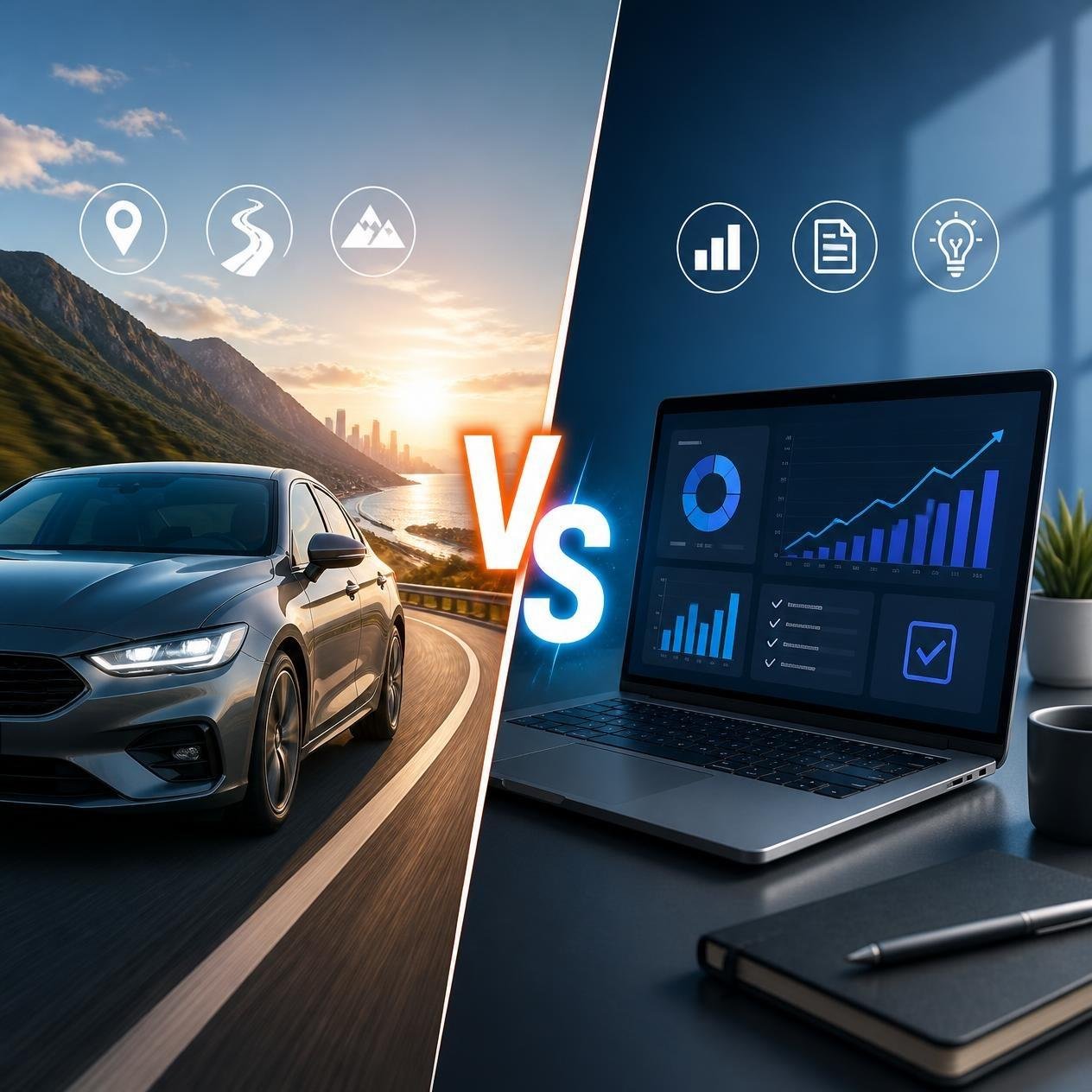
Cars and laptops are priced on the same five things: how new they are, how powerful they are, how much they hold, what class they belong to, and the brand behind them.
Walk into a car yard in Nairobi and then into a laptop shop on Moi Avenue, and the conversations sound surprisingly alike. The car dealer talks about year, engine and horsepower. The laptop seller talks about generation, processor and RAM. Different words, same logic.
This article explains each pair step by step, and why each one moves the price. Once you see the pattern, you can judge whether almost any car or laptop is fairly priced.
Step 1: Age — year of manufacture vs. processor generation
Newer machines cost more because they have more useful life ahead of them.
Cars. A 2023 Toyota costs far more than the same model from 2013. The newer car has modern safety systems such as more airbags and lane assist, better fuel economy, updated infotainment, and an engine and suspension with little wear.
Laptops. The laptop equivalent is the processor generation, for example Intel 8th Gen versus 13th Gen. Each new generation runs faster, uses less power, and supports the latest software and security updates.
Why it moves the price. Both products depreciate. An older car is closer to costly repairs, and an older laptop is closer to being too slow for new programs. Buyers pay a premium for years of trouble-free use still to come.
Step 2: Power — horsepower vs. RAM
More working power means more expensive parts, and buyers pay for the ability to handle heavy loads without strain.
Cars. Horsepower measures how much work the engine can do. A car with 300 horsepower accelerates faster, overtakes safely, climbs hills easily and can tow a trailer. A car with 100 horsepower struggles when fully loaded.
Laptops. RAM decides how many tasks a laptop can juggle at once. With 8GB, a laptop slows down when you open many browser tabs, a video call and a spreadsheet together. With 16GB or 32GB, it handles design software, video editing and heavy multitasking smoothly.
Why it moves the price. Delivering more power needs stronger, costlier components. Buyers who carry heavy loads, on the road or on screen, are willing to pay for machines that do not slow down.
Step 3: The heart of the machine — engine capacity vs. processor
The engine and the processor are the most complex parts in each machine, so they set the price band more than anything else.
Cars. Engine capacity, measured in cc, is the size of the engine. A 1300cc car is built for light city driving, a 2000cc car for comfort on the highway, and a 2700cc or larger engine for heavy SUVs and rough terrain.
Laptops. The processor is the laptop's engine. Intel's Core i3, i5, i7 and i9, or AMD's Ryzen 3, 5, 7 and 9, run from basic to top-tier. Every click, calculation and app depends on it.
Why it moves the price. Bigger engines and faster processors cost more to design and manufacture. They also cost more to run: a large engine burns more fuel, and a powerful processor needs better cooling and a bigger battery. That is why a Core i7 laptop is priced above a Core i3, just as a 2700cc vehicle is priced above a 1300cc one.
Step 4: Capacity — seating vs. storage
More capacity raises the price, but only when you compare machines of the same class.
Cars. Seating capacity tells you how many people, and how much luggage, a vehicle can carry. A 7-seater family SUV usually costs more than a 5-seater saloon from the same maker, because it needs a bigger body, more materials and a stronger chassis.
Laptops. Storage tells you how many files, programs, photos and videos a laptop can hold. A 1TB SSD costs more than a 256GB SSD, and fast SSD storage costs more than an older hard disk.
Why it moves the price, and its limit. Extra capacity means extra material and engineering. But capacity is not the whole story. A two-seater Ferrari costs many times more than a 14-seater matatu, and a premium laptop with 512GB can cost more than a budget one with 1TB. What decides the bigger price gap is class, covered in the next step.
Step 5: Class and purpose — why one brand sells both cheap and expensive models
The same brand prices its models very differently because each one is built for a different buyer and purpose.
Toyota Land Cruiser Prado TX vs. Toyota Corolla. Both carry the Toyota badge, but they are different machines. The Prado TX is a full-size 4x4 SUV with a large engine, a body-on-frame chassis, four-wheel drive for murram and rough roads, more seats and a higher driving position. The Corolla is a compact saloon built to be affordable, economical and easy to maintain in town. The Prado is engineered to do far more, and it is priced accordingly.
HP Spectre vs. HP EliteBook. The EliteBook is HP's business line, built for durability, security features and reliability that companies buy in bulk. The Spectre is HP's premium consumer line, with a slim aluminium body, sharp OLED or high-resolution touchscreens, a 2-in-1 hinge that folds into a tablet, a stylus and luxury finishing. Much of the Spectre's extra cost pays for design and materials rather than raw power.
Why it moves the price. Manufacturers build tiers so they can serve both budget and premium buyers. Higher tiers get better materials, more features and more careful design, and they are aimed at people willing to pay for them.
Step 6: Specialized performance — sports cars vs. gaming laptops
Machines built for peak performance cost the most, even though they give up everyday practicality.
Ferrari. A Ferrari sits low to the ground and is shaped for speed. It uses a high-revving engine, an aerodynamic body, racing-grade brakes and lightweight materials such as carbon fibre, and it is made in small numbers. It carries only two people and little luggage, yet its price is many times that of a family car.
HP Omen. A gaming laptop is the sports car of computing. The Omen packs a dedicated graphics card such as an NVIDIA RTX, a fast high-refresh-rate screen, a powerful processor and an advanced cooling system with extra fans and heat pipes. These parts let it run demanding games and 3D software smoothly.
Why it moves the price. Top performance needs specialized, expensive components. Both machines also produce a lot of heat and need extra cooling. And both trade comfort for speed: a Ferrari is impractical on potholed roads, while a gaming laptop is heavier, louder and shorter on battery life than an ordinary one.
Step 7: Other factors that follow the same pattern
Several smaller factors also line up between the two markets.
- Mileage vs. battery health. A car with 200,000 km on the clock sells for less than one with 40,000 km. A laptop whose battery holds half its original charge also sells for less.
- Fuel economy vs. battery life. Buyers pay more for a car that is cheap to run and a laptop that lasts a full working day unplugged.
- Extra features. Sunroofs, leather seats and reverse cameras lift a car's price. Touchscreens, backlit keyboards, fingerprint readers and better webcams do the same for laptops.
- Brand reputation and resale value. In Kenya, Toyota holds its value well because parts are easy to find and mechanics know it. Among laptops, HP, Dell, Lenovo and Apple keep strong resale value for similar reasons.
- Condition and origin. A locally used car is priced below a fresh import, and an ex-UK refurbished laptop is priced below a brand-new one.
At a glance: the parallels side by side
|
Car |
Laptop |
What it tells the buyer |
|---|---|---|
|
Year of manufacture |
Processor generation |
How modern it is and how long it will last |
|
Horsepower |
RAM |
How much work it handles at once |
|
Engine capacity (cc) |
Processor tier (i3 to i9) |
Core performance |
|
Seating capacity |
Storage capacity |
How much it can hold |
|
Corolla vs. Prado TX |
EliteBook vs. Spectre |
Class, purpose and finish |
|
Ferrari |
HP Omen |
Specialized peak performance |
|
Mileage |
Battery health |
Wear and remaining life |
|
Fuel economy |
Battery life |
Day-to-day running cost |
The bottom line: pay for what you will actually use
Buyers of cars and laptops pay for the same things: newness, power, capacity, class and a trusted brand. The more a machine can do, the longer it will last, and the more refined or specialized it is, the higher its price.
The smartest buyers match the machine to the job. A student who writes assignments and browses does not need an HP Omen, just as a family doing school runs in town does not need a Ferrari. Before you buy, ask three questions:
- What will I use it for every day?
- How many years do I want it to last?
- Which features am I paying for that I will never use?
Answer those honestly, and you will know whether a price is fair, whether you are shopping on the car yard or in the laptop shop.
- Nairobi City Updates
- Nairobi City Estates
- Nairobi City Culture
- Nairobi City Roads
- Nairobi City Nightlife
- Nairobi City Trusted Businesses
- Nairobi City Fitness and Aports
- Nairobi City Accommodation Options
- Nairobi City Service Providers
- Nairobi City Gallery
- Newly Out in Nairobi
- Nairobi City Price Lists
- Food
- Gardening
- Health
- Other
- Nairobi City Places
- Sports
- Nairobi News & Opinion
- Nightlife
- Places & Reviews
- Travel & Getaways
- Business & Money
- Tech
- Culture & Lifestyle
- Fashion & Beauty
- Relationships
- Sports Talk
 English
 Arabic
 French
 Spanish
 Deutsch
 Italiano
 Romaian
 Portuguese (Brazil)
 Greek
Greek